
Création d’une salle informatique dans un local existant
Et si j’installais ma nouvelle salle informatique dans ce local de stockage à 10 mètres des bureaux des équipes informatiques ? Bonne idée ! Ou pas …
La mise en œuvre d’un datacenter dans des locaux existants nécessite d’en valider la faisabilité en vérifiant quelques points essentiels.
Quelle est la surface et la résistance de votre salle existante ?
Premier point à vérifier : la résistance du sol de la salle. Le poids cumulé des composants techniques (baies informatiques, onduleurs, climatisations) et surtout des serveurs et autres systèmes de stockage peut dépasser les 1 000 kg par m². En conséquence, la résistance du sol du local cible devra être supérieure ou égale à 1 tonne/m². Sachant que les bureaux ont souvent des résistances de sol limitées à 250 kg/m², il faudra soit prévoir un renforcement du plancher (par pose de plaques de répartition ou de plats carbones) soit simplement changer de local. Attention, un plancher technique ne répartit pas la charge.
Autre point à vérifier : tout simplement la surface disponible. La mise en œuvre d’un datacenter modulaire nécessite selon le Tier souhaité une surface suffisante pour y intégrer les composants et locaux électriques, climatiques, de sécurité et bien sûr les baies informatiques, avec un espace suffisant en allées froides et chaudes pour permettre une exploitation aisée de la salle. Qui dit modularité dit évolutivité : penser à bien prendre en compte l’évolutivité souhaitée en capacité électrique, climatique et en nombre de baies.
D’autres points techniques à appréhender pour accueillir un nouveau Datacenter
Concernant l’enveloppe du local, la mise en œuvre d’une solution automatique de détection et extinction incendie à gaz nécessite une bonne étanchéité des murs, sol et plafond pour garantir la conservation du gaz dans le datacenter pendant la phase d’extinction. Les fissures, passages de câbles et ouvertures vers l’extérieur de la salle doivent être rebouchées, tâche souvent difficile en présence d’un plancher technique historique non purgé. Les portes du datacenter quant à elles doivent permettre une évacuation rapide : elles doivent donc s’ouvrir vers l’extérieur de la salle et être munies soit d’une barre anti-panique, soit d’une serrure qui puisse être déverrouillée par la solution de détection incendie.
Concernant l’arrivée des alimentations électriques et des liens réseau, la contrainte principale est souvent le cheminement des câbles. S’assurer que des chemins de câbles peuvent être utilisés ou ajoutés jusqu’au local, idéalement en utilisant deux arrivées séparées à la fois pour l’alimentation électrique et pour les arrivées réseau.
Pour la climatisation du datacenter, les contraintes dépendent de la technologie envisagée. En climatisation à eau glacée, vérifier si un réseau de capacité suffisante existe sans plage d’indisponibilité. Dans le cas contraire, vérifier que des groupes froid peuvent être positionnés à proximité relative du datacenter et qu’un réseau de tuyauterie peut être créé jusqu’à celle-ci. Ces dernières contraintes sont identiques pour des climatisations à détente directe.
La mise en œuvre d’un datacenter dans un bâtiment existant impose donc de vérifier en amont les contraintes techniques potentielles.
Des alternatives existent cependant si l’une de ces contraintes s’avère bloquante : par exemple la réalisation d’une salle en panneaux modulaires dans un entrepôt ou un parking ou encore l’installation d’un datacenter en container.
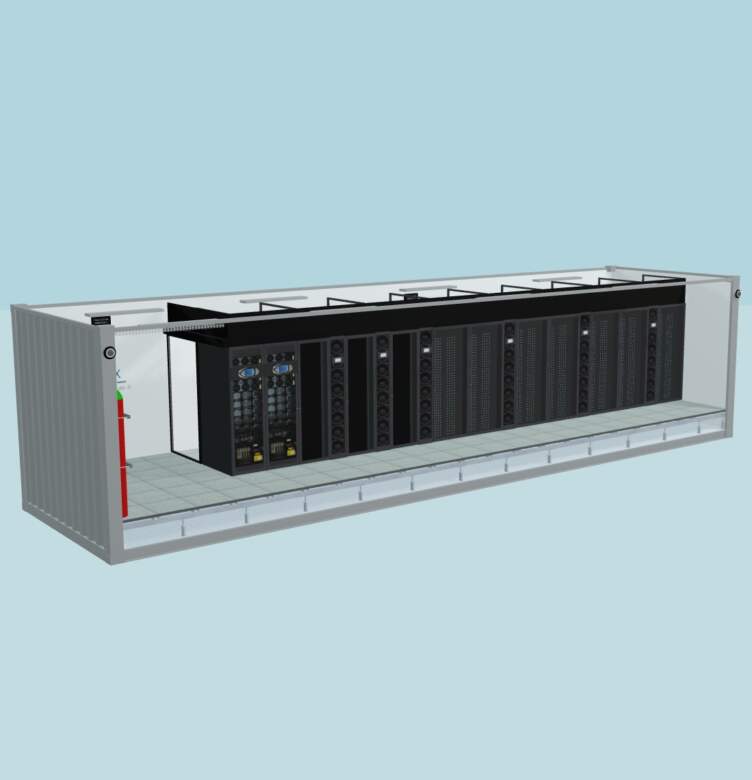
Construisez votre propre Datacenter en container
Parce que votre futur Datacenter doit répondre à votre type d’activité et à vos besoins en terme d’évolutivité, Module-it a développé un configurateur dynamique vous permettant d’obtenir en une minute le Datacenter adapté à vos attentes.