
Efficacité énergétique dans les Datacenters
La sécurité avant l’efficience énergétique des Datacenters
Sujet de nombreux articles et communications commerciales, l’efficacité énergétique des Datacenters est un enjeu majeur des datacenters pour les années à venir.
Il est important en préambule de bien repréciser que l’objectif numéro un des Datacenters est la sécurité de fonctionnement et d’accès aux données hébergées. L’efficience énergétique, aussi louable soit-elle, ne doit pas venir dégrader la sécurité par des choix d’architectures efficientes.
Bien que des indicateurs comme le PUE existent depuis de nombreuses années et poussent à standardiser, à benchmarker et à tirer vers le haut les constructeurs et opérateurs de Datacenter, il est à noter qu’il n’existe pas à ce jour en Europe de cadre légal contraignant obligeant les propriétaires des Datacenters à opérer sous un seuil particulier d’efficacité énergétique (comme on peut l’avoir dans le secteur automobile par exemple).

Comment optimiser l’efficacité d’un Datacenter ?
L’efficacité ou efficience énergétique d’un Datacenter peut se travailler à partir des axes de conception suivants :
- Bien définir son premier palier d’installation via une conception la plus modulaire possible : Les composants techniques comme les groupes froid, climatisations, onduleurs, transformateurs etc. délivrent leur meilleur rendement avec un taux d’utilisation le plus élevé possible. Ainsi il est crucial lors de la conception de réussir avec les DSI à bien définir les premiers paliers d’installation. Outre la réduction des coûts initiaux, il y aura des impacts directement sur les coûts de maintenance et de consommations électriques.
- Comme précisé en préambule, la sécurité de fonctionnement primant, la redondance des chaines techniques à un impact direct sur le rendement énergétique d’un Datacenter. En effet, la charge informatique est répartie sur les différentes chaines en redondance et donc naturellement baisse le rendement énergétique de chaque composant.
- Les technologies de refroidissement utilisées ont aussi un impact fort sur l’efficience énergétique d’un datacenter. En fonction de la localisation du Datacenter, du niveau de redondance attendu, du type d’informatiques hébergées, des contraintes de sécurité physique et du budget total alloué, différentes technologies comme le free-cooling direct, indirect, free-chilling peuvent être mis en œuvre.
- Enfin, la récupération d’énergie ou de chaleur est un autre facteur d’amélioration du rendement global de la solution. Pour cela, il faut identifier un consommateur à proximité du Datacenter (réseau de chaleur urbain, d’entreprise, chauffage de batiment, piscine etc.) ou bien un producteur de froid comme le puisage de l’eau de lac.
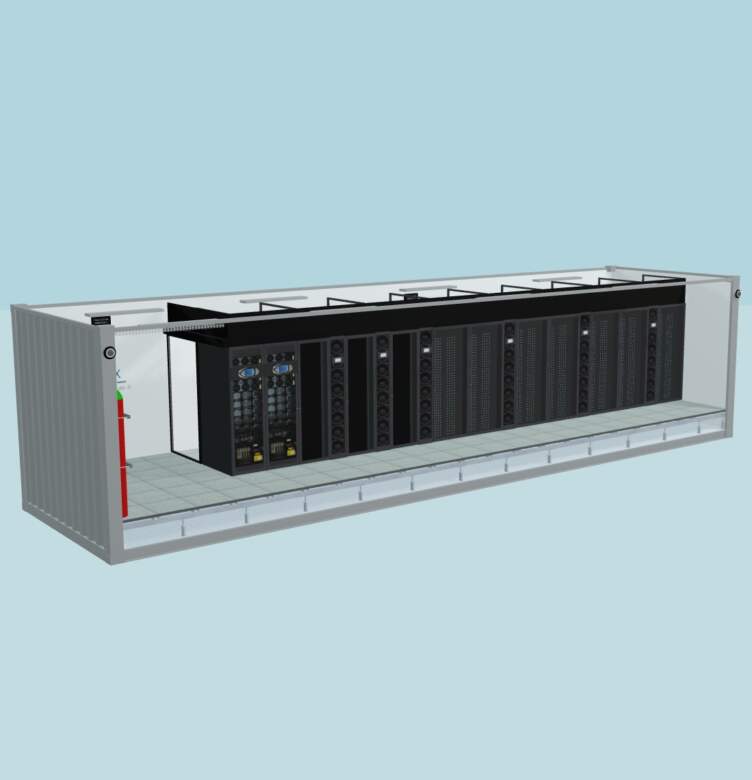
Construisez votre propre Datacenter en container
Parce que votre futur Datacenter doit répondre à votre type d’activité et à vos besoins en terme d’évolutivité, Module-it a développé un configurateur dynamique vous permettant d’obtenir en une minute le Datacenter adapté à vos attentes.