
GTC vs DCIM – La supervision des Datacenters
Les Datacenters ont cette particularité d’appartenir au monde bâtimentaire ET au monde informatique.
Cette bivalence a des conséquences importantes sur le bon maintien en condition opérationnel et en particulier sur la supervision en temps réel du Datacenter avec des cas de figures de dysfonctionnement comme ceux-ci-dessous :
- Dé-responsabilisation des équipes bâtimentaires et/ou informatique sur la supervision du Datacenter
- Non partage des niveaux de service attendus et donc mauvaise création d’alerte ou d’indicateurs de supervision
- Outils de supervision obsolètes et ne reflétant plus avec le temps la réalité du Datacenter qui a évolué
- Notion de redondance non prise en compte dans la supervision
- Pas de gestion prédictive ou capacitaire du Datacenter
L’erreur vient souvent du fait de croire qu’un outil unique peut répondre aux attentes de toutes les organisations. De l’expérience que nous avons tiré de plus de 120 implémentations de Datacenters, dans la majorité des cas, deux outils distincts sont nécessaires pour que le Datacenter soit correctement supervisé.
La Gestion Technique Centralisée (GTC) d’un Data Center
Le premier outil à destination des services généraux ou technique de l’entreprise s’appuie sur une base de GTC ou BMS. Outil de type industriel, il s’appuie sur des protocoles éprouvés et instantanés comme les contacts secs, le MODBUS ou le BacNet.
Les informations remontées sont plutôt du type alerte booléen avec quelques informations numériques. On mettra en œuvre des synoptiques techniques avancés et statiques (architectures électriques, synoptiques hydrauliques, état des composants ASI dont l’onduleur, les batteries, les climatisations, l’état des vannes, des groupes électrogènes etc…)
Les tableaux de bord simplifiés sont à disposition des équipes externes de supervision ou des PCS interne. Pour cet outil de supervision de Datacenter, nous allons chercher la rapidité, la simplicité et l’exhaustivité des informations remontées.
Superviser son Data Center avec le DCIM
Le second outil à destination des DSI est un outil de supervision DCIM (DataCenter Infrastructure Management) tel qu’on les connait pour les supervisions réseaux. S’appuyant principalement sur des trames SNMP, les informations par composants (climatisations, ASI etc…) sont très nombreuses.
On va chercher plutôt à superviser des tendances, courbes, moyennes. Les indicateurs sont plus complexes (comme des moyennes ou des deltas de températures, PUE etc…).
Les alertes d’un DCIM peuvent être plus prédictives car s’appuyant sur des augmentations fortes ou des seuils de pré-alertes. Les notifications peuvent être envoyées vers différentes personnes avec des possibilités de suivre l’état des alertes et d’escalader.
La modélisation métier du Datacenter réalisé dans le DCIM (urbanisation, densité, positionnement des climatisations) permettra aussi d’étudier les contraintes et interactions entre les différentes chaînes techniques et de se projeter dans le futur.
Pour cet outil de supervision de Datacenter DCIM, nous allons cette fois-ci chercher la capacité de modélisation, la conservation d’une multitude de données dans le temps, et la des fonctions de reporting évoluées et flexibles.
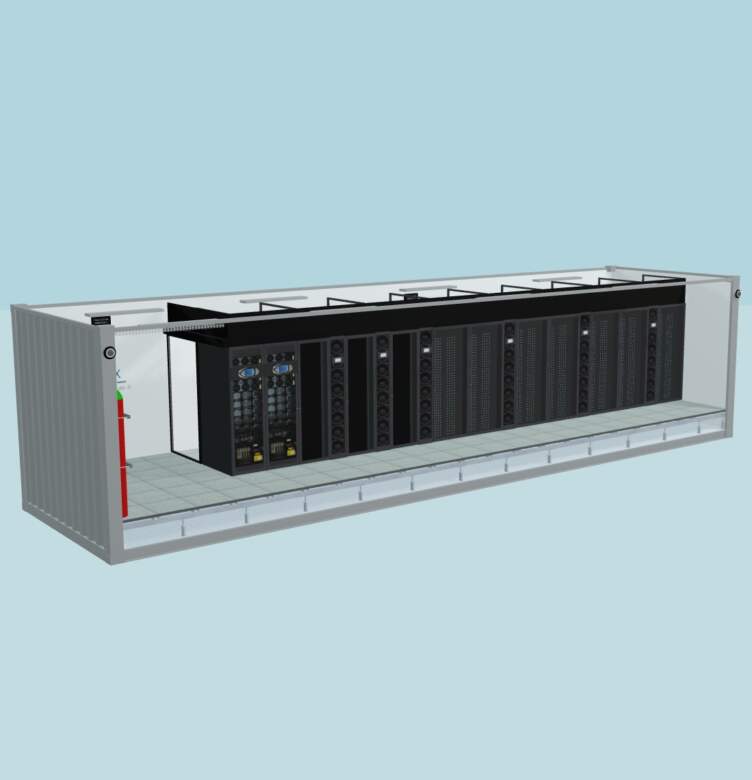
Construisez votre propre Datacenter en container
Parce que votre futur Datacenter doit répondre à votre type d’activité et à vos besoins en terme d’évolutivité, Module-it a développé un configurateur dynamique vous permettant d’obtenir en une minute le Datacenter adapté à vos attentes.