
Sécurité physique, sécurité incendie
Que votre Datacenter héberge vos propres données ou les données de vos clients, la hausse croissante de leur importance et de leur sensibilité impose aujourd’hui la mise en œuvre de solutions de sécurité spécifiquement adaptées.

Pourquoi renforcer la sécurité de votre Datacenter ?
Vols ou sabotages des données ou des matériels, installation de matériel espion, intervenants indélicats : les exemples d’actes de malveillance en salles informatiques sont nombreux avec des conséquences souvent catastrophiques pour les sociétés touchées.
Tout comme un antivirus et un firewall protègent l’accès aux données, la mise en œuvre d’une solution complète de contrôle d’accès, d’alarme et de vidéosurveillance protège l’accès aux zones sensibles de votre Datacenter.
La mise en œuvre d’une solution de sécurité physique permet entre autres :
- De gérer précisément les autorisations d’accès du personnel et des visiteurs à la salle informatique et aux locaux techniques,
- D’assurer la protection d’un travailleur isolé,
- De dissuader les personnes mal intentionnées, internes ou externes à l’entreprise, par la présence de caméras judicieusement positionnées,
- De responsabiliser les salariés et intervenants extérieurs lors d’interventions dans le Datacenter,
- D’alerter en cas de tentative d’accès pour déclencher l’intervention d’agents de sécurité,
- D’identifier les auteurs et le déroulement des opérations s’il y a eu acte ou tentative de malveillance.
Les logiciels modernes, conformes aux réglementations CNIL et RGPD, sont connectés et multisites. Ils remontent instantanément les alertes et permettent une identification et une analyse rapide des anomalies par des outils intelligents de recherche d’évènement sur images vidéo.
La certification ANSSI délivrée par l’Autorité Nationale de Sécurité des Système d’Information impose la mise en œuvre de composants particuliers et doit être prise en compte dès le début du projet de mise en œuvre.
Autre source de dégâts majeurs dans les datacenter : les incendies. Dont les conséquences peuvent une nouvelle fois être humainement et financièrement catastrophiques pour une entreprise.
La rapidité nécessaire à l’étouffement d’un départ de feu avant sa propagation rend la mise en œuvre d’une simple solution de détection totalement inefficace.
Nous préconisons donc l’installation d’une solution autonome et automatique de détection et d’extinction incendie (ou IEAG : Installation d’Extinction Automatique à Gaz) conforme aux règles APSAD R7 et R13.
Deux système de détection peuvent cohabiter :
- une détection précoce par aspiration, préconisée pour la salle informatique,
- une détection classique par détecteurs incendie multicritères pour les locaux techniques.
Dans le cadre d’une extinction à gaz, le gaz d’extinction peut être soit de l’azote pur, soit un mélange d’azote et d’argon (IG-55). Ces gaz agissent sur les foyers par étouffement en réduisant le taux d’oxygène de la salle en moins de 60 secondes.
L’atmosphère dans les locaux protégés reste respirable.
Les buses de diffusion des gaz sont de type silencieuses dans les salles serveurs pour diminuer le bruit et éviter tout risque de dégradation du matériel informatique.
L’assurance de votre entreprise pourra exiger un asservissement des systèmes électriques et des climatisations en cas de détection incendie, donc un arrêt de production de la salle.
Si cet avertissement n’est pas obligatoire, nous préconisons dans la plupart des cas de maintenir l’alimentation électrique et le fonctionnement des climatisations en cas d’extinction incendie : le gaz extincteur sera brassé de manière homogène par les climatisations et votre production informatique ne sera pas coupée.
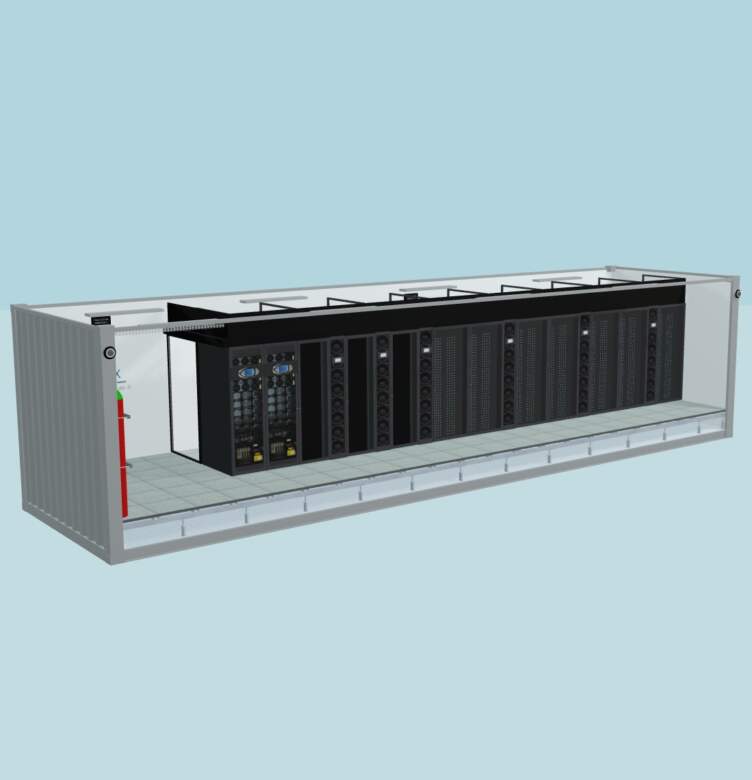
Construisez votre propre Datacenter en container
Parce que votre futur Datacenter doit répondre à votre type d’activité et à vos besoins en terme d’évolutivité, Module-it a développé un configurateur dynamique vous permettant d’obtenir en une minute le Datacenter adapté à vos attentes.